Ang Department of Education o Kagawaran ng Edukasyon
DepEd pushes for school-level class resumption rules to stop loss of learning days
MAKATI CITY, 18 August 2026— To curb learning losses caused by frequent class disruptions, the Department of Education (DepEd) is pushing for updated emergency guidelines that give schools the authority to declare granular, school-level class resumptions following disasters and severe weather.
Under the proposed Executive Order (EO), individual schools that remain safe or recover quickly from emergencies may resume in-person classes, even while broader localized suspensions remain in effect, subject to local government unit (LGU) concurrence and documented safety assessments.
The proposal follows extensive nationwide consultations held with local chief executives, schools division superintendents, school heads, teachers, parents, and learners that showed broad support for decisions based on actual conditions on the ground.
Education Secretary Sonny Angara emphasized that blanket class cancellations have severely disrupted basic education, making site-specific precision necessary to balance learner safety with learning continuity.
“In line with the directive of President Ferdinand R. Marcos Jr. to protect learner safety while recovering lost learning time, we need a policy that reflects ground realities,” Angara said, noting in School Year 2023–2024 alone, public schools lost up to 53 teaching days to weather disturbances and non-instructional interruptions.
“While safety will always remain our non-negotiable priority, we can no longer rely on broad, blanket suspensions where an entire city shuts down even when individual campuses are dry, safe, and ready to teach,” Angara added.
“If a school is clear, accessible, and certified safe, our learners should be back in the classroom without delay.”
DepEd expressed optimism that President Ferdinand R. Marcos Jr. will approve the proposed EO before the end of the year to ensure long-term stability in basic education.
The proposal updates Executive Order No. 66, s. 2012 which focused on automatic and localized suspension of classes and work in government offices during weather disturbances and calamities. The updated draft establishes standardized rules for both class suspensions and resumptions across a wider spectrum of natural and human-induced hazards, including extreme heat, earthquakes, power outages, and poor air quality.
The updated framework introduces school-level granular resumption as a central innovation. When a city- or municipal-wide suspension is active, individual public school heads can initiate class resumptions based on a documented site-specific assessment, provided they receive concurrence from the local chief executive (LCE). Private basic education schools may declare resumptions in prompt coordination with the LCE.
The policy also preserves school-level suspension powers established under DepEd Order No. 22, s. 2024. School heads may suspend in-person classes during isolated campus-level hazards, such as localized flooding or power failures, with the concurrence of their Schools Division Superintendent (SDS).
To ensure decisions remain objective and responsive, all declarations must be supported by verifiable evidence. Under the proposed rules, LGUs and Schools Division Offices will operate within a structured one-hour concurrence window upon receiving a school’s safety assessment.
During the consultations, LGUs welcomed the framework’s reliance on local chief executives as concurring authorities for granular resumptions, noting that local leaders have direct oversight of community safety.
Meanwhile, parents and teachers emphasized the need for prompt announcements, transparent safety checks, and structured distance learning protocols to ensure learning continuity when disruptions occur.
The consultations also reinforced the importance of shared responsibility and strong LGU-SDO coordination, clear indicators, timely announcements and safety assessments before resuming face-to-face classes.
END
Angara honors fallen Tacloban learner hero, SJNHS staff with DepEd Heroes Award
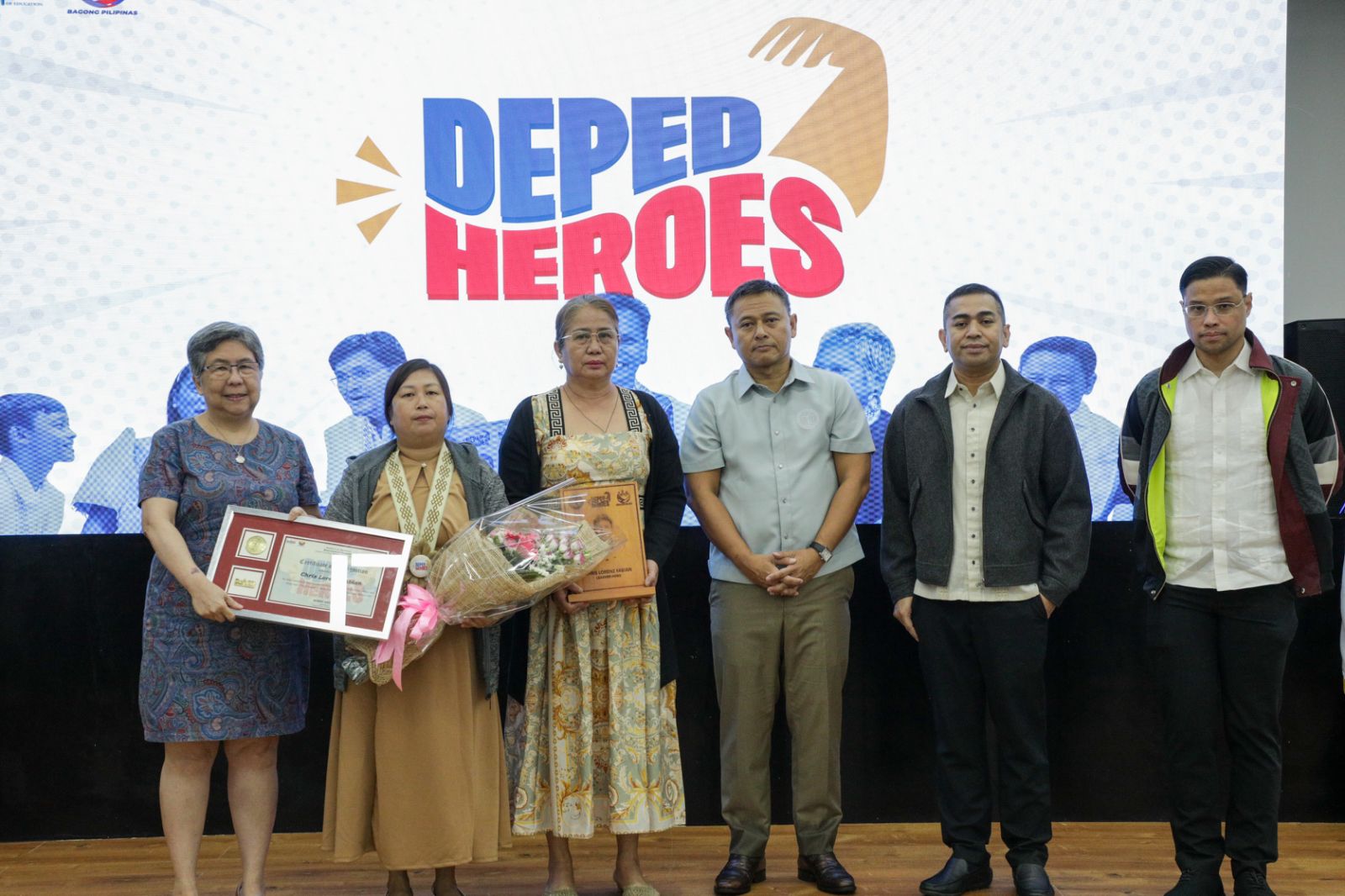
MAKATI CITY, 17 August 2026— Education Secretary Sonny Angara on Monday conferred the Department of Education (DepEd) Heroes Award on the late 15-year-old Boy Scout Chris Lorenz Fabian, a Grade 10 learner from San Jose National High School (SJNHS) in Tacloban City, and the school’s faculty and staff for their extraordinary courage during a June 22 campus shooting.
The ceremony, held during the launch of the second year of the DepEd Heroes program, honored the late Grade 10 learner posthumously for sacrificing his life to protect his classmates. When an assailant attempted to enter their classroom, Fabian held the door shut to give his classmates time to take cover, sustaining fatal injuries in the process.
Secretary Angara praised the young learner for his selfless choice to prioritize his classmates’ safety during an emergency, noting that his actions demonstrate that true courage is not defined by age. While acknowledging that no award can ease the grief of losing a child, Angara emphasized that DepEd remains dedicated to ensuring that Chris’s sacrifice is never forgotten.
“Kung may matututunan tayo sa nangyari, hindi na natin papabayaan siguro yung kalagayan ng ating mga kabataan para umabot doon sa punto na magsama-sama tayo bilang isang DepEd community,” Angara said. “We need to make sure that all of our children feel seen and all members of the DepEd community feel seen also.”
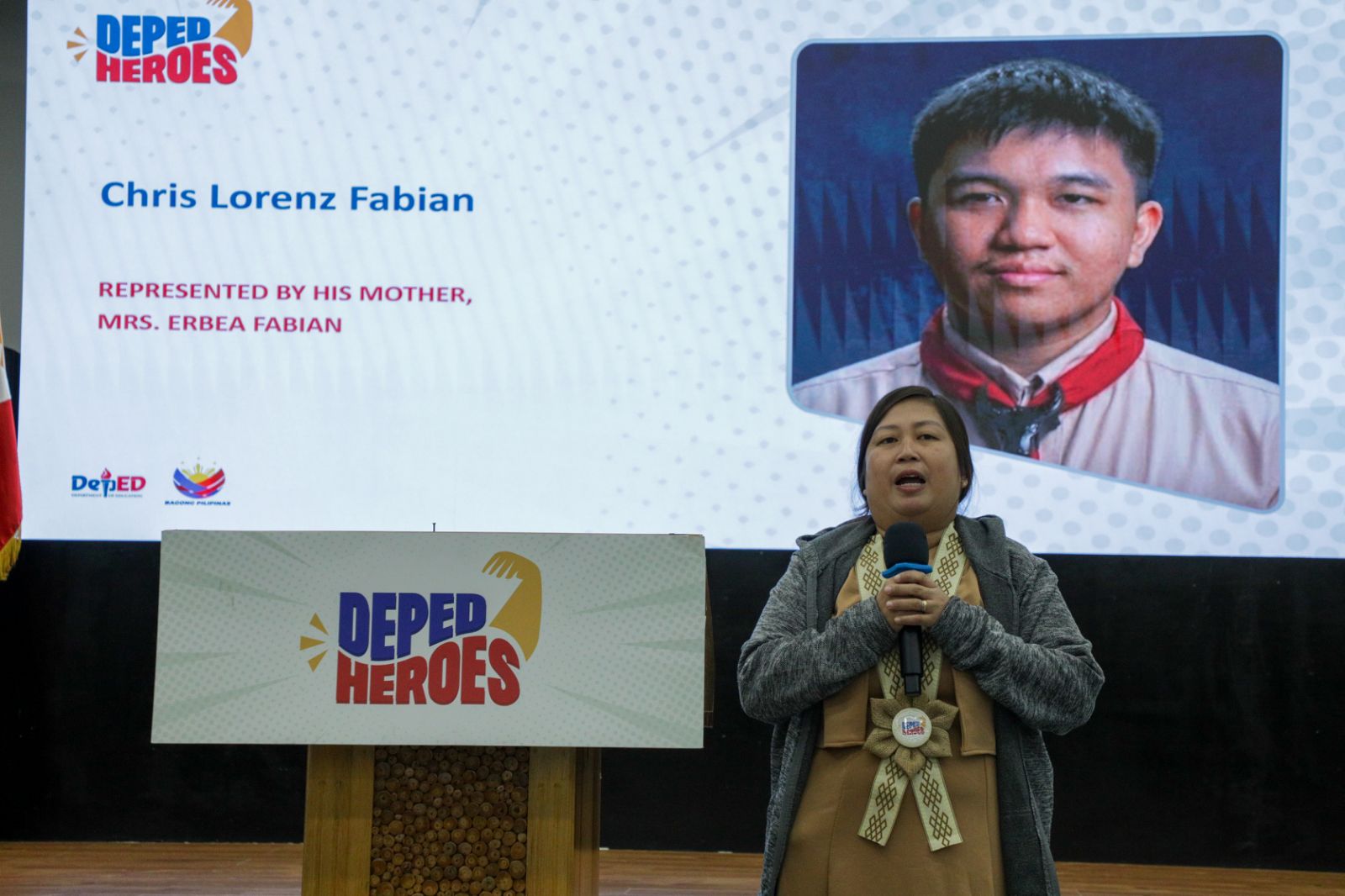
Fabian’s award was accepted on his behalf by his mother, Erbea Fabian, alongside his grandmother, Aleth Fabian.
“Siya po ay isang batang may napakalaking puso, napakabuting asal. Ito po ay napatunayan hindi dahil sa anak ko siya kung hindi dahil sa nangyari noong June 22 sa kanyang school. Bata pa po siya ay mas inuuna na niya ang kanyang kapwa bago ang kanyang sarili,” Mrs. Erbea Fabian said.
She expressed her deep gratitude to Secretary Angara for personally visiting their family, and thanked DepEd for honoring her son with the hero’s recognition.
Angara also cited the faculty and staff of SJNHS, represented by School Head Dr. Liezl Pulga and Filipino Reading Coordinator Rosalyn Rosite, for their presence of mind, leadership, and coordinated emergency response in securing classrooms and shielding learners during the assault.
Accepting the recognition on behalf of the school community, Pulga emphasized that the honor belonged to the entire SJNHS family.
“When I think of the journey that brought us here, I think of our teachers who continued to serve despite difficult circumstances, our non-teaching personnel who quietly kept everything moving, our parents and partners who stood beside us, and most especially, our learners who continued to show courage even during moments of fear and uncertainty,” Pulga said.
She said that the recent tragedy tested their strength as educators and as a community, but proved that the school stood united in the face of crisis.
“When its people stand together, a school can overcome even the most difficult days. I accept this recognition with humility, but I also accept it as a responsibility—to continue leading with courage, to listen with compassion, to protect our learners, and to keep building a school where every child feels safe, valued, and hopeful,” Pulga said.
She thanked Secretary Angara and the DepEd Central Office for creating the initiative, underscoring that learners need to be seen and supported. “Your recognition means so much to us because it tells our school community that our efforts are seen and our service matters,” she said.
Highlighting the administration’s priority for learner protection, Angara underscored President Ferdinand Marcos Jr.’s directive to secure educational institutions nationwide.
“Bago tayo maging pursigido dito sa ating mga learner initiatives, siguraduhin muna natin na ‘yung ating mga bata ay nasa tamang kalagayan at tamang pag-iisip,” Angara emphasized, reinforcing the need to make sure that learners feel seen.
“Mismong si Pangulong Bongbong ay nagpulong sa amin at sinabi niya mismo na bawat teacher sa bawat paaralan ay kailangan may assignment na bata, na ang trabaho niya ay hindi tulungan ang bata kundi kumustahin ang bata,” he added.
In line with President Marcos’s directive, DepEd is leading a nationwide, whole-of-government school safety campaign. DepEd is enforcing strengthened security measures under the Guidelines on Ensuring a Safe and Motivating Learning Environment (ESMLE) per DepEd Order No. 006, s. 2026.
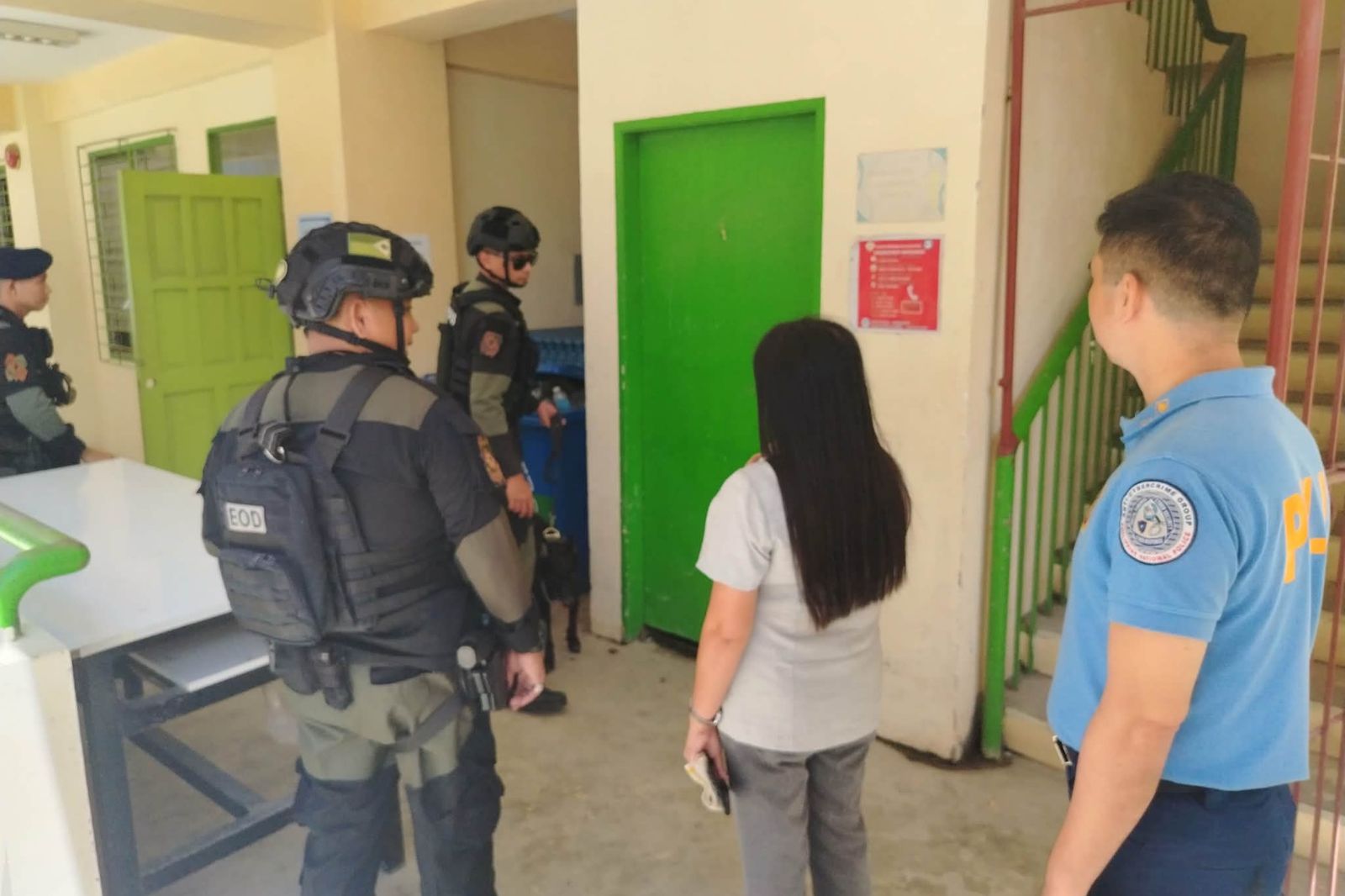
Public schools nationwide are implementing enhanced security protocols, including handheld metal detectors, strict visitor controls, regular bag inspections, and security personnel deployment, as well as active threat drills.
The DepEd Heroes program was launched in August 2025 to recognize the extraordinary acts of service, bravery, and dedication of educators, learners, and personnel nationwide.
END
DepEd mobilizes immediate classroom clearing operations as habagat disrupts over 8M learners
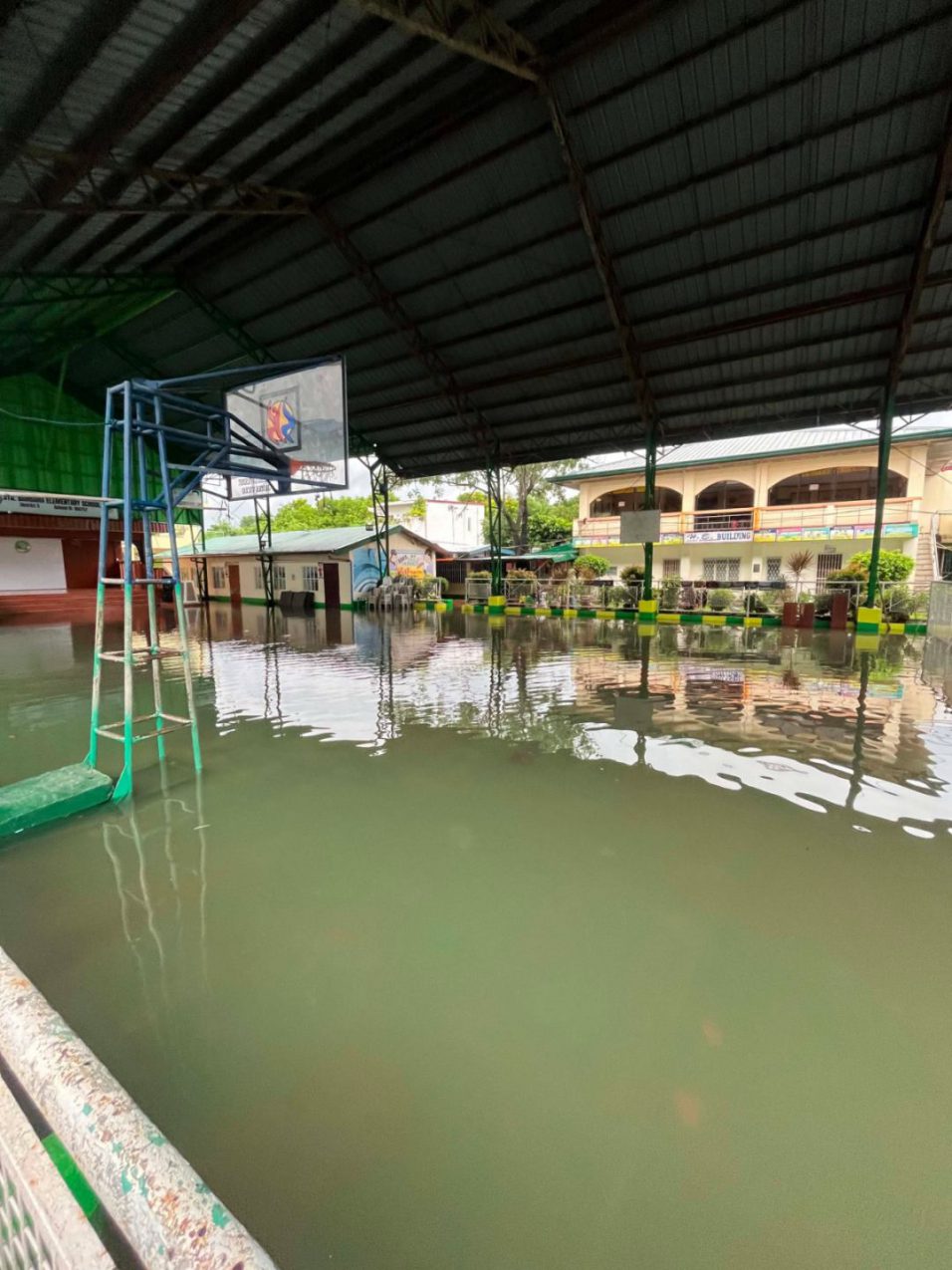
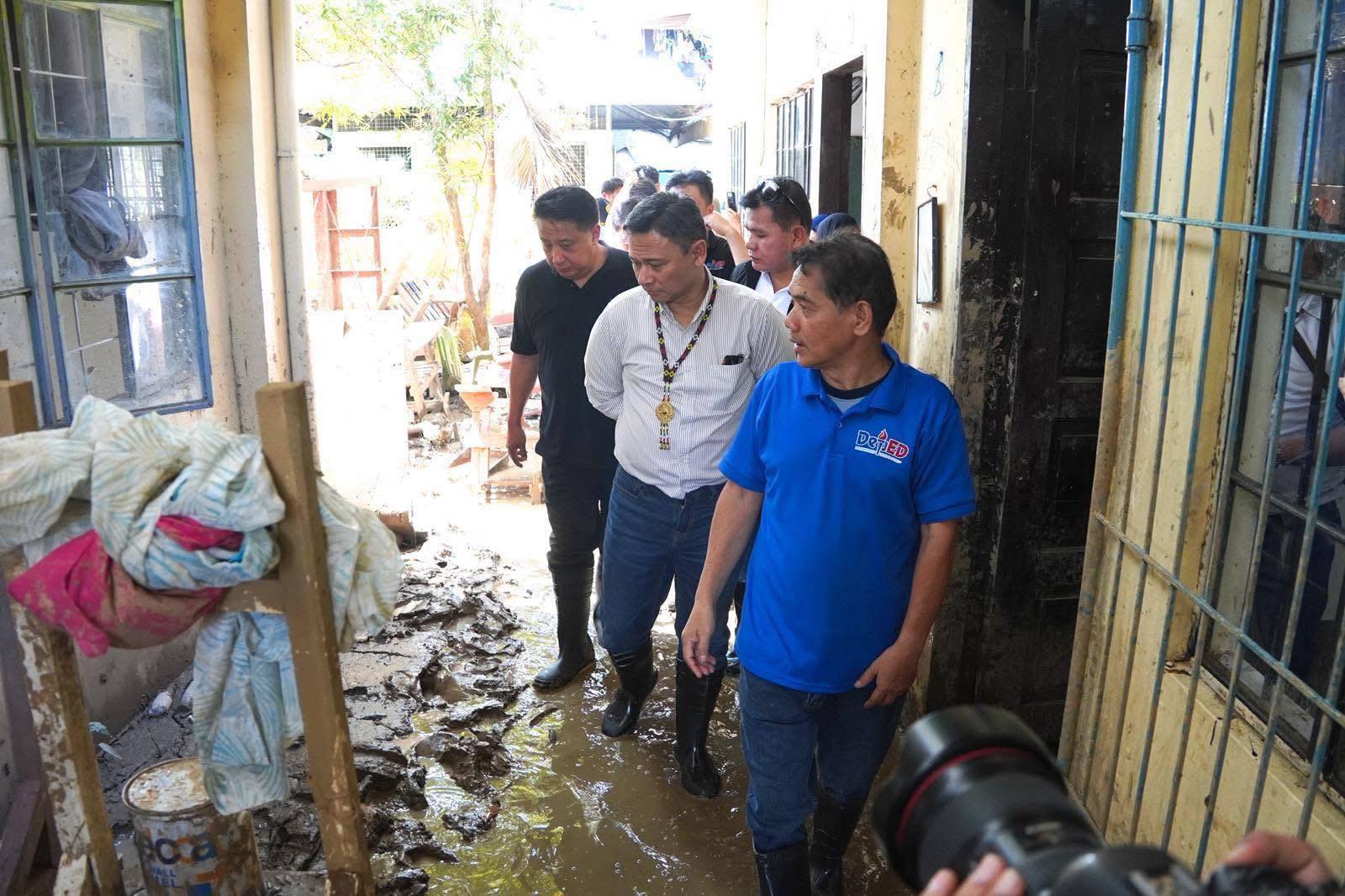
MAKATI CITY, 14 August 2026— The Department of Education (DepEd) has initiated rapid disaster response operations and outlined immediate recovery requirements following severe operational disruptions caused by the southwest monsoon (habagat), enhanced by Tropical Cyclone Maymay.
Based on assessments as of August 14, the weather system has impacted eight regions across 73 DepEd divisions. Around 8.4 million learners and 365,308 DepEd personnel have seen their daily educational activities disrupted due to active in-person class suspensions affecting 12,477 public schools.
Education Secretary Sonny Angara emphasized that while physical safety remains the absolute priority, the Department is moving fast to minimize learning loss and restore damaged infrastructure.
“Unang-una sa lahat, ang kaligtasan ng ating mga mag-aaral, guro, at kawani ang aming pangunahing prayoridad. Ngunit habang sinisigurado natin ang kanilang seguridad, hindi natin pwedeng hayaang matigil nang matagal ang pag-aaral ng ating mga kabataan,” Secretary Angara said.
“Ginagawa ng DepEd ang lahat para makabalik agad sa ligtas na pag-aaral ang ating mga estudyante,” Angara added.
To ensure swift learning continuity, the DepEd Disaster Risk Reduction and Management Service (DRRMS) has initiated the processing of the initial batch of recovery funds amounting to PHP 19.14 million.
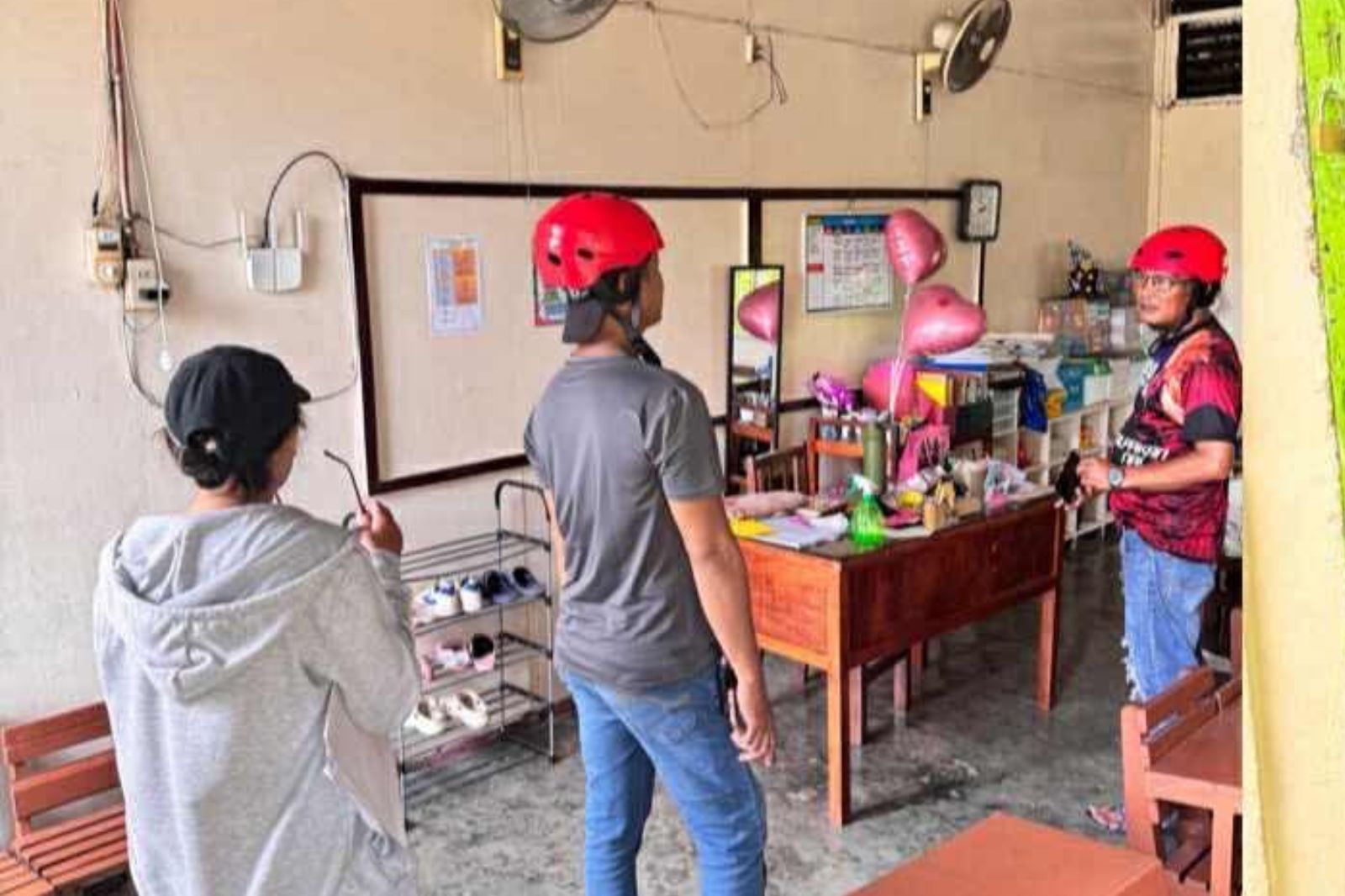
The disaster recovery framework covers funds for clean-up and clearing operations for 1,244 affected schools, and minor repair to restore 4,259 classrooms with minor structural damage.
In addition to physical repairs, field monitoring indicates that 230 public schools are serving as primary evacuation sites housing 6,840 families across 837 classrooms.
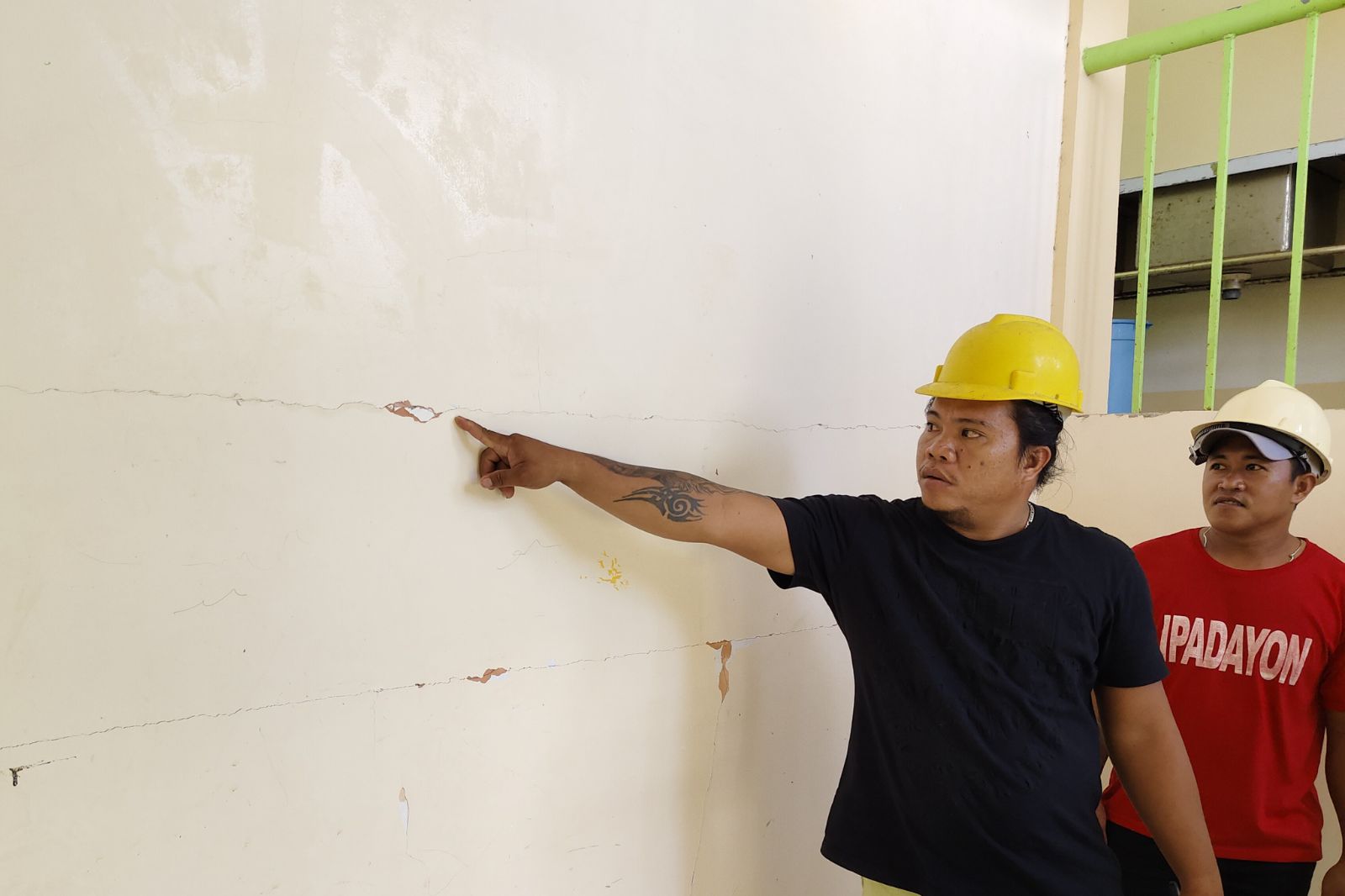
Overall infrastructure damage includes 1,423 classrooms with major damage and 1,395 totally damaged classrooms. Reported non-infrastructure asset losses stand at 16,981 learning materials, 11,151 school chairs, and 579 units of IT equipment.
DepEd continues to work closely with local government units (LGUs) and regional disaster management councils to monitor weather developments, streamline resource deployment, and coordinate local school clearances.
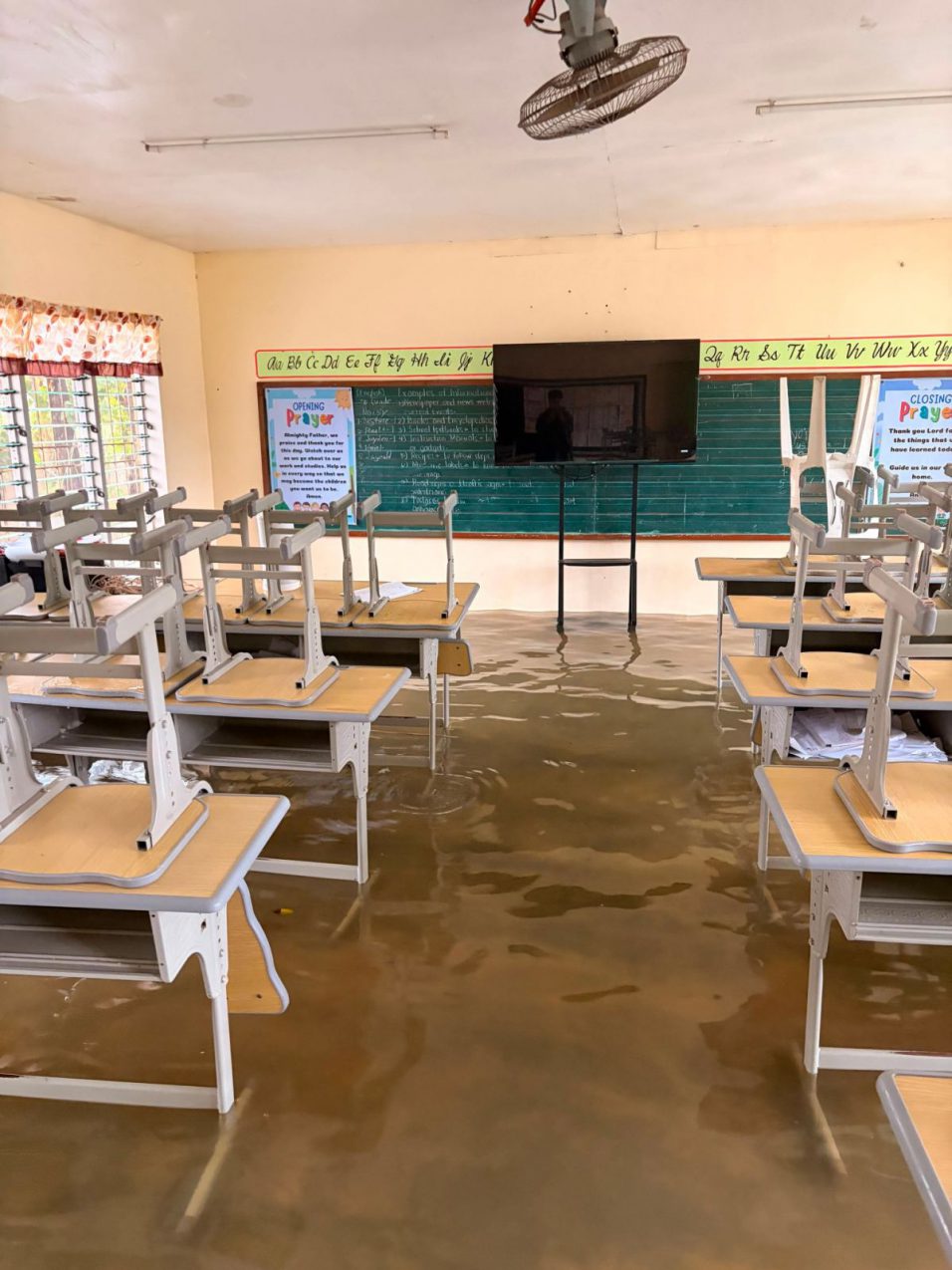
Where physical classroom access remains unsafe or impossible due to lingering floodwaters or their use as evacuation sites, schools have been authorized to implement alternative learning delivery modalities to maintain educational continuity.
END
DepEd activates emergency measures as Habagat brings heavy rains, class disruptions
MAKATI CITY, 10 August 2026 — The Department of Education (DepEd) activated its emergency learning measures as heavy rains brought by the Southwest Monsoon disrupted classes in Metro Manila and several provinces, reminding schools and field offices to apply the Department’s Education in Emergencies framework to protect learners, teachers, and school personnel.
The reminder follows Memorandum Circular No. 123 of the Office of the President, which directed alternative learning modes in affected areas today, unless otherwise directed by local chief executives.
DepEd said the current weather situation highlights the need for schools to use the 4H protocol — Hayo, Hinay, Hinga, and Hinto— to guide decisions on learning delivery based on safety, learner readiness, available resources, and local conditions.
Education Secretary Sonny Angara said the policy is designed to help schools respond to disruptions in a way that protects learners and teachers while keeping learning possible when conditions allow.
“Kapag malakas ang ulan, baha ang daan, o may risk sa safety ng learners at teachers, hindi puwedeng one-size-fits-all ang decision. Kailangan malinaw ang batayan: ligtas ba, kaya ba, at anong klaseng learning support ang angkop? Iyan ang layunin ng 4H framework — gabayan ang schools kung kailan tutuloy, kailan babagalan, kailan hihinga, at kailan kailangang huminto muna,” Angara said.
Under the framework, Hinto is applied when conditions are unsafe or when learners’ safety, protection, or basic needs are at risk. At this level, academic activities are temporarily stopped so schools and communities can prioritize safety, emergency response, and essential support.
Hinga is used when learners, teachers, and school personnel need time to recover from stress, disruption, or displacement. Schools may conduct well-being checks, psychosocial support, and light asynchronous activities, but submissions and regular academic requirements should not be required.
Hinay, or the yellow level, applies when there is disruption but learning can continue in an adjusted and teacher-supervised manner, either through synchronous or asynchronous modalities depending on available resources, connectivity, and local conditions.
Hayo is activated once conditions have returned to normal and regular learning can safely resume.
DepEd emphasized that in areas where local governments or schools have shifted to asynchronous or alternative learning modes due to the current rains, these arrangements may be treated as Hinay, provided that learners and teachers are safe and learning requirements are adjusted to the situation.
The Department reminded schools that learning continuity during emergencies does not mean forcing regular academic work during unsafe or highly stressful conditions. Instead, schools must calibrate learning based on actual risk, available access, and the well-being of learners and personnel.
“Sa ganitong panahon, ang unang dapat isipin ay kaligtasan. May mga sitwasyong kailangang Hinto muna, may kailangan ng Hinga para makabawi, may puwededng mag-Hinay sa pamamagitan ng adjusted learning, at may babalik sa Hayo kapag normal na ang lahat. Ang mahalaga, hindi natin ipipilit ang iisang response sa magkakaibang sitwasyong ne learners, teachers, at mga komunidad,” Angara said.
DepEd also directed schools to coordinate with local government units, disaster risk reduction and management offices, and field offices in determining the appropriate learning continuity level.
Schools were also reminded to update their Learning and Service Continuity Plans, maintain emergency communication channels with learners and parents, and ensure that academic requirements remain reasonable during weather-related disruptions.
The Department said Regional Offices and Schools Division Offices shall continue providing technical assistance to schools, particularly in areas affected by heavy rains, flooding, landslides, and other hazards.
Through the 4H protocol and ready-to-deploy learning provisions, DepEd aims to support schools in making timely, humane, and context-sensitive decisions that protect learners and teachers while sustaining learning wherever safe and appropriate. On Mon, Aug 10, 2026 at 12:27 PM DepEd Communications Division <pas.cd@deped.gov.ph> wrote:
PRESS RELEASE DepEd activates emergency measures as Habagat brings heavy rains, class disruptions
MAKATI CITY, 10 August 2026 — The Department of Education (DepEd) activated its emergency learning measures as heavy rains brought by the Southwest Monsoon disrupted classes in Metro Manila and several provinces, reminding schools and field offices to apply the Department’s Education in Emergencies framework to protect learners, teachers, and school personnel.
The reminder follows Memorandum Circular No. 123 of the Office of the President, which directed alternative learning modes in affected areas today, unless otherwise directed by local chief executives.
DepEd said the current weather situation highlights the need for schools to use the 4H protocol — Hayo, Hinay, Hinga, and Hinto— to guide decisions on learning delivery based on safety, learner readiness, available resources, and local conditions.
Education Secretary Sonny Angara said the policy is designed to help schools respond to disruptions in a way that protects learners and teachers while keeping learning possible when conditions allow.
“Kapag malakas ang ulan, baha ang daan, o may risk sa safety ng learners at teachers, hindi puwedeng one-size-fits-all ang decision. Kailangan malinaw ang batayan: ligtas ba, kaya ba, at anong klaseng learning support ang angkop? Iyan ang layunin ng 4H framework — gabayan ang schools kung kailan tutuloy, kailan babagalan, kailan hihinga, at kailan kailangang huminto muna,” Angara said.
Under the framework, Hinto is applied when conditions are unsafe or when learners’ safety, protection, or basic needs are at risk. At this level, academic activities are temporarily stopped so schools and communities can prioritize safety, emergency response, and essential support.
Hinga is used when learners, teachers, and school personnel need time to recover from stress, disruption, or displacement. Schools may conduct well-being checks, psychosocial support, and light asynchronous activities, but submissions and regular academic requirements should not be required.
Hinay, or the yellow level, applies when there is disruption but learning can continue in an adjusted and teacher-supervised manner, either through synchronous or asynchronous modalities depending on available resources, connectivity, and local conditions.
Hayo is activated once conditions have returned to normal and regular learning can safely resume.
DepEd emphasized that in areas where local governments or schools have shifted to asynchronous or alternative learning modes due to the current rains, these arrangements may be treated as Hinay, provided that learners and teachers are safe and learning requirements are adjusted to the situation.
The Department reminded schools that learning continuity during emergencies does not mean forcing regular academic work during unsafe or highly stressful conditions. Instead, schools must calibrate learning based on actual risk, available access, and the well-being of learners and personnel.
“Sa ganitong panahon, ang unang dapat isipin ay kaligtasan. May mga sitwasyong kailangang Hinto muna, may kailangan ng Hinga para makabawi, may puwededng mag-Hinay sa pamamagitan ng adjusted learning, at may babalik sa Hayo kapag normal na ang lahat. Ang mahalaga, hindi natin ipipilit ang iisang response sa magkakaibang sitwasyong ne learners, teachers, at mga komunidad,” Angara said.
DepEd also directed schools to coordinate with local government units, disaster risk reduction and management offices, and field offices in determining the appropriate learning continuity level.
Schools were also reminded to update their Learning and Service Continuity Plans, maintain emergency communication channels with learners and parents, and ensure that academic requirements remain reasonable during weather-related disruptions.
The Department said Regional Offices and Schools Division Offices shall continue providing technical assistance to schools, particularly in areas affected by heavy rains, flooding, landslides, and other hazards.
Through the 4H protocol and ready-to-deploy learning provisions, DepEd aims to support schools in making timely, humane, and context-sensitive decisions that protect learners and teachers while sustaining learning wherever safe and appropriate.
END
DepEd activates emergency measures as Habagat brings heavy rains, class disruptions
MAKATI CITY, 10 August 2026 — The Department of Education (DepEd) activated its emergency learning measures as heavy rains brought by the Southwest Monsoon disrupted classes in Metro Manila and several provinces, reminding schools and field offices to apply the Department’s Education in Emergencies framework to protect learners, teachers, and school personnel.
The reminder follows Memorandum Circular No. 123 of the Office of the President, which directed alternative learning modes in affected areas today, unless otherwise directed by local chief executives.
DepEd said the current weather situation highlights the need for schools to use the 4H protocol — Hayo, Hinay, Hinga, and Hinto— to guide decisions on learning delivery based on safety, learner readiness, available resources, and local conditions.
Education Secretary Sonny Angara said the policy is designed to help schools respond to disruptions in a way that protects learners and teachers while keeping learning possible when conditions allow.
“Kapag malakas ang ulan, baha ang daan, o may risk sa safety ng learners at teachers, hindi puwedeng one-size-fits-all ang decision. Kailangan malinaw ang batayan: ligtas ba, kaya ba, at anong klaseng learning support ang angkop? Iyan ang layunin ng 4H framework — gabayan ang schools kung kailan tutuloy, kailan babagalan, kailan hihinga, at kailan kailangang huminto muna,” Angara said.
Under the framework, Hinto is applied when conditions are unsafe or when learners’ safety, protection, or basic needs are at risk. At this level, academic activities are temporarily stopped so schools and communities can prioritize safety, emergency response, and essential support.
Hinga is used when learners, teachers, and school personnel need time to recover from stress, disruption, or displacement. Schools may conduct well-being checks, psychosocial support, and light asynchronous activities, but submissions and regular academic requirements should not be required.
Hinay, or the yellow level, applies when there is disruption but learning can continue in an adjusted and teacher-supervised manner, either through synchronous or asynchronous modalities depending on available resources, connectivity, and local conditions.
Hayo is activated once conditions have returned to normal and regular learning can safely resume.
DepEd emphasized that in areas where local governments or schools have shifted to asynchronous or alternative learning modes due to the current rains, these arrangements may be treated as Hinay, provided that learners and teachers are safe and learning requirements are adjusted to the situation.
The Department reminded schools that learning continuity during emergencies does not mean forcing regular academic work during unsafe or highly stressful conditions. Instead, schools must calibrate learning based on actual risk, available access, and the well-being of learners and personnel.
“Sa ganitong panahon, ang unang dapat isipin ay kaligtasan. May mga sitwasyong kailangang Hinto muna, may kailangan ng Hinga para makabawi, may puwededng mag-Hinay sa pamamagitan ng adjusted learning, at may babalik sa Hayo kapag normal na ang lahat. Ang mahalaga, hindi natin ipipilit ang iisang response sa magkakaibang sitwasyong ne learners, teachers, at mga komunidad,” Angara said.
DepEd also directed schools to coordinate with local government units, disaster risk reduction and management offices, and field offices in determining the appropriate learning continuity level.
Schools were also reminded to update their Learning and Service Continuity Plans, maintain emergency communication channels with learners and parents, and ensure that academic requirements remain reasonable during weather-related disruptions.
The Department said Regional Offices and Schools Division Offices shall continue providing technical assistance to schools, particularly in areas affected by heavy rains, flooding, landslides, and other hazards.
Through the 4H protocol and ready-to-deploy learning provisions, DepEd aims to support schools in making timely, humane, and context-sensitive decisions that protect learners and teachers while sustaining learning wherever safe and appropriate.
END
DepEd seeks stronger ties with DPWH, LGUs to build more access roads to schools
MAKATI CITY, 17 July 2025 — The Department of Education (DepEd) is pushing for a stronger partnership with the Department of Public Works and Highways (DPWH) and local government units (LGUs) to construct more access roads to public schools, especially in geographically isolated and disadvantaged areas.
The initiative aligns with President Ferdinand R. Marcos Jr.’s commitment to improving access to essential services through strategic infrastructure and supports DepEd’s broader push to remove physical barriers to learning.
In a formal proposal to DPWH, DepEd recommended the inclusion of access roads to public schools in the department’s programming and investment plans, especially for newly constructed schools with no road access.
Education Secretary Sonny Angara underscored the importance of the initiative, drawing from his recent visits in last mile schools in Mindanao.
“Noong pumunta kami sa Buenavista, Agusan del Norte, nakita natin ang realidad. May mga estudyanteng kailangang tumawid ng ilog at umakyat ng bundok para lang makapasok sa paaralan. Hindi puwedeng puro classrooms lang ang itatayo natin kung wala namang daan papunta roon,” Angara said.
“Kung may farm-to-market road, dapat may road-to-school din,” he added.
DepEd also pointed to DPWH’s successful infrastructure collaborations with other agencies, such as the Tourism Road Infrastructure Program (TRIP) with the Department of Tourism (DOT), the Farm-to-Market Road Development Program (FMRDP) with the Department of Agriculture (DA), and the Roads Leveraging Linkages of Industry and Trade (ROLL-IT) with the Department of Trade and Industry (DTI)) as strong models of interagency coordination.
To support this push, DepEd is proposing a special provision under its FY 2026 Basic Education Facilities Fund (BEFF) that all newly constructed school buildings have corresponding access roads with the DPWH and LGUs to immediately include the construction of roads in cases where none is available.
DepEd said it looks forward to working closely with DPWH and local government units to identify priority areas and ensure that no school and learner is left behind.
END
Healthier schools under PBBM: DepEd, DOH strengthen support for safe, health-promoting campuses
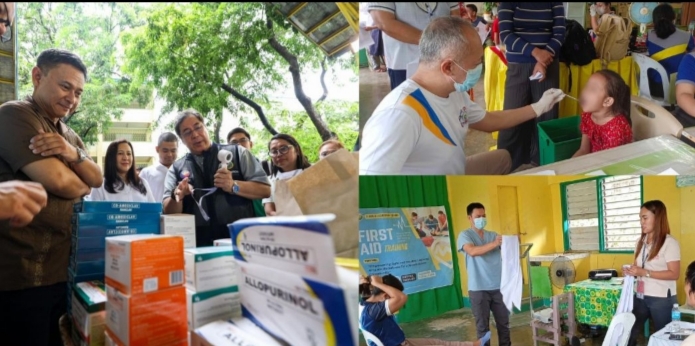
MAKATI CITY, 8 July 2025 — From remote mountain schools to urban classrooms, public schools across the country are seeing tangible improvements through a multi-agency initiative aimed at transforming schools into health-promoting environments, aligned with President Ferdinand R. Marcos Jr.’s directive to ensure safer, healthier spaces for learners.
Central to this effort is the Department of Education’s (DepEd) Healthy Learning Institutions (HLI) program, a nationwide strategy implemented in partnership with the Department of Health (DOH), local government units, and school communities.
In the upland village of Bantay, Ilocos Sur, Taguiporo Elementary School was once a “Last Mile School” with two-star sanitation and limited health services. Now, it stands among the 38 Outstanding Last Mile Schools awardees of the DOH’s Healthy Learning Institutions Awards. After receiving a ₱100,000 grant from the DOH, the school built new gender-sensitive and PWD-friendly toilets, expanded its feeding program and mental health and dental services, and launched a backyard garden that now feeds learners and families.
“Dati, marami sa mga bata ang may sakit at laging umaabsent,” Principal Teresita Peredo said. “Pero ngayon, mas healthy, mas masaya, at mas involved na rin ang mga parents.”
This transformation is just one of more than 1,500 school-level success stories under the OK sa DepEd–HLI initiative, which began in 2022. The program follows a Joint Administrative Order (JAO No. 2022-0001) signed by DepEd, DOH, CHED, DILG, DSWD, TESDA, and LEB. It operationalizes Section 30 of the Universal Health Care Act by designating schools as “healthy settings” based on standards developed with WHO guidance and local policies.
The initiative establishes clear standards across six pillars of school health and well-being, using a self-appraisal system to assess implementation. In 2024, a three-tier recognition system was introduced, certifying schools as ‘Satisfactory,’ ‘Very Satisfactory,’ or ‘Outstanding’ based on their percentage of compliance with the established standards.
To date, more than 1,300 of the participating schools are classified as “Last Mile,” those with limited access to basic facilities and resources. Many have received direct financial support from the DOH to kick-start improvements, ranging from hygiene facilities to mental health training. In Taguiporo, this meant building functional toilets and wash areas.
National onboarding sessions, scheduled this July 14 to 15, are expected to further capacitate school leaders and health officers in implementing the HLI framework. Tools like the School Self-Appraisal Checklist and a shared “Map of Materials” for health promotion are also being distributed nationwide.
While the program currently runs on a provisional setup, the Department is finalizing a DepEd Order to institutionalize the HLI framework in all public schools. The Order, set for release this year, will formalize the three-star rating system and embed the standards within DepEd’s broader Learner Support Framework.
“Hindi lang dapat ligtas sa sakuna ang paaralan. Dapat ligtas din sa gutom, sa sakit, at sa kawalan ng suporta. Sa Healthy Learning Institutions program, tinitiyak nating may sapat na kaalaman, kalusugan, at malasakit sa bawat silid-aralan,” Education Secretary Sonny Angara said.
Future expansions include joint DOH-DepEd-DILG guidelines on school-based reproductive and mental health services, and emergency protocols for disease outbreaks, reinforcing schools as the frontlines of both education and well-being.
In the words of Principal Peredo, “Makikita mo sa ngiti ng mga bata ang tagumpay.”
With HLI, schools are nurturing health as a shared responsibility with the community.